


Share
Posted 06/09/23
Launching a Drone business? 4 Key Questions to Consider
You could be mistaken for thinking that drones are a relatively recent phenomenon, but drones have in fact been around for many years. Used in military circles since the nineteenth century (the first known drone made an appearance in 1849), they play a critical role within the government and defence sector and have always courted controversy. However, we are witnessing a significant evolution of the drone and its capabilities and use cases. Grand View Research forecasts that the global commercial drone market size was estimated at USD19.89 billion in 2022 and is expected to grow at a compound annual growth rate (CAGR) of 13.9% from 2023 to 2030.
This impressive predication is testament to the way that the drone is gradually permeating into everyday life and considered a vital tool that can assist across an array of use cases. They’re already finding their way into mission-critical scenarios such as wildfire and natural disaster monitoring, aerial surveys of oil and gas pipelines, farm monitoring and crop health, medical deliveries, search and rescue, law enforcement – and this is just the beginning.
"technology and use cases are rapidly evolving while regulators are doing their best to keep up"
I’ve witnessed the explosion in drone technology and lucky to have been a part of some ground-breaking projects over the last few years. Getting an idea off the ground is a hard path to navigate in any business, but in the drone industry, it has the added complexity of being a nascent market – technology and use cases are rapidly evolving while regulators are doing their best to keep up, supporting the innovation while balancing risk and safety. This is nothing new in aviation and F H Sykes’s (the first Controller General of Civil Aviation Air Ministry) quote comes to mind “It has not always been easy to administer the Regulations so as to secure the safety of the public without handicapping the expansion of [the industry]”. As applicable today as it was back then in 1919.
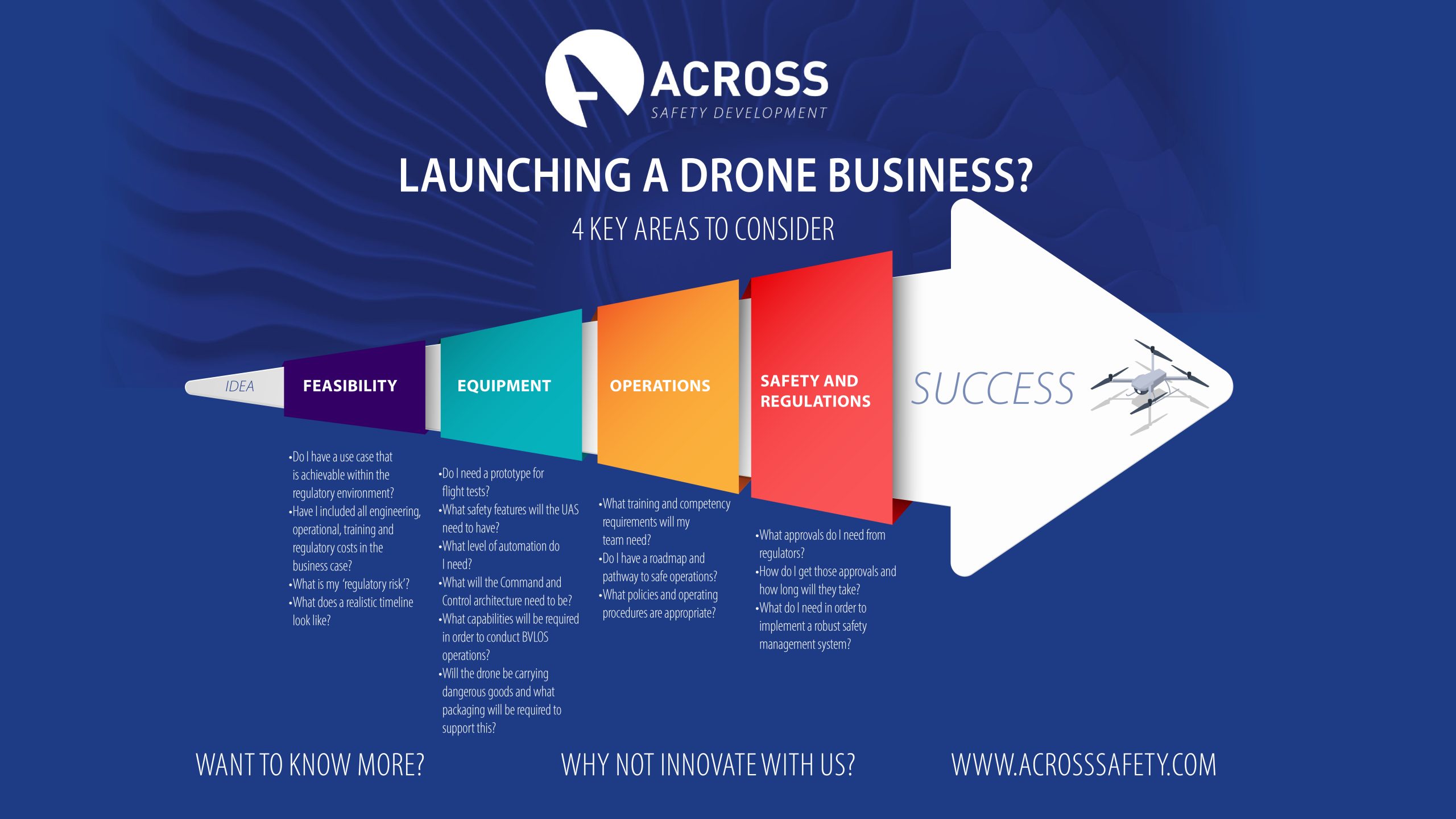
So what are those crucial factors a UAS start-up should be thinking about before they start their journey? What is going to improve their chances of success? Here are my top 4 questions all UAS start-ups should be asking:
1. Is my idea feasible and does the business case stack up?
This might sound obvious, but it’s also very easy to get wrong. Once a business has started off down its path it can be very difficult and costly to backtrack.
Ask yourself:
- Do I have a business case that is achievable within the regulatory environment?
Understand your costs as much as possible up front. In addition to the obvious operational and capital costs associated with a commercial drone operation, there can be quite a few surprises along the way, especially around regulations and engineering.
"It’s absolutely crucial to understand the regulations you’re planning on operating under before you set out."
It’s absolutely crucial to understand the regulations you’re planning on operating under before you set out. What is your ‘regulatory risk’ in terms of achieving the approval you need? How long is it likely to take to get your approval? Are you looking to conduct operations that already have a well known approval pathway, or will you be looking to break new ground? What’s your exposure to air and ground risks? Is it going to be on the high side of the regulatory risk scale? Is the operation even possible in the current regulatory environment?
Another area that catches organisations out is how regulations will impact the design (and cost) of a drone. Being aware of the safety features that the aircraft will need to have in order to be approved for flight testing or the ultimate use case you have in mind eg. Having independent redundant systems or features like a parachute. This might not be included in the prototype but an engineer will need to factor that in during the design phase and have a cost allocated to it in the business case.
2. Have you got the right equipment?
As well as the safety features that come with the regulatory requirements, there will be many other questions to ask yourself when identifying the equipment you’ll need:
- Do I need a prototype for flight tests?
- What are the different payload requirements and can the drone accommodate them in the way that’s intended?
- Will it be operating in extreme weather?
- What will the Command and Control architecture need to be?
- What capabilities will be required in order to conduct BVLOS operations?
- Will the drone be carrying dangerous goods and what packaging will be required to support this?
3. Does your team possess the necessary skills to carry out your intended flight operations?
Drone use cases can vary from relatively simple VLOS flights to complex BVLOS operations in challenging environments, utilising sophisticated customised equipment and multi-crew coordination across dispersed locations. Understanding what the training and competency requirements are going to look like is vital in ensuring a robust roadmap to safe operations.
4. What about risk and safety?
And last but not least, ask yourself:
- Do I have a robust risk and safety management strategy in place?
Safety management systems have proven their value over many years in the crewed aviation sector. They are intended to facilitate a clear picture of your risk landscape which in turn enables the efficient allocation of resources to key risk areas. At its core an SMS answers a series of fundamental safety risk management questions:
What is most likely to be the cause of your next accident or serious incident?
- How do you know that?
- What are you doing about it?
- Is it working?
Want to know more?
Across Safety is a champion of new aviation technologies. We are a trusted partner in regulation, training and safety to some of the industry’s top innovators. Why not innovate with us too?
To find out more about how we can help you to realise your operation’s ambitions, get in touch


